October 21, 2026



IN THE END, there was no divine intervention for the City of Quincy.
After a lower court judge temporarily blocked the city from installing 10-foot-tall bronze statues of Catholic patron saints on the facade of its new public safety building, siding with the residents who sued to stop it as impermissible government support for religion, the city appealed to the Supreme Judicial Court.
On Thursday, the state’s highest court upheld the judge’s injunction, deciding that he ruled correctly that the city’s actions likely violated the state’s bar on government favoring a particular religion.
In 2023, without seeking city council approval or making a public announcement, Quincy Mayor Thomas Koch commissioned two statues — St. Michael the Archangel, patron saint of police officers, and St. Florian, patron saint of firefighters — that would cost an estimated $850,000 and frame the entryway of the $175 million, four-story, 120,000-square-foot building replacing the city’s old police station.
In a unanimous decision, the SJC held that a Norfolk Superior Court judge was in the right to halt installation of the statues. A group of residents had standing as taxpayers to sue over the use of public funds, according to the court, and the judge applied the correct test to determine whether the statue approval and installation was constitutional.
The lower court record, SJC Justice Scott Kafker wrote, “reflects that the statues are large and will stand alone, they are brand new rather than long standing, they are closely affiliated with a particular religion, and they thus may convey to observing members of the public implicit government support for that religion and, as a result, subordination of other religions.”
This means the statues will be kept in storage and off the building while litigation continues at the lower court level. The visages of a winged Michael and towering Florian extinguishing fire await further judgment, but the ruling signals a rough legal road ahead for Quincy.
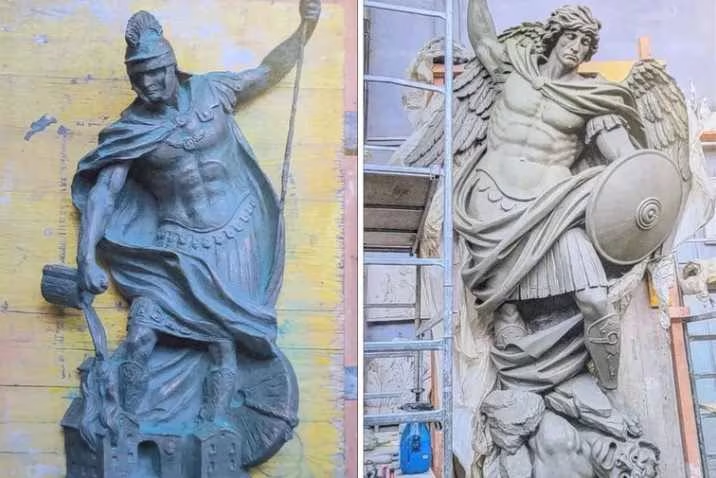
Koch did not initially bring the statue plan to the city council, which had already approved funding for the public safety building, or disclose it publicly. The Patriot Ledger first reported on the statues in February 2025, kicking off intense public backlash that included a petition with more than 1,600 signatures and a joint statement from an interfaith coalition of South Shore clergy.
Fifteen Quincy residents, represented by the ACLU of Massachusetts along with the Freedom From Religion Foundation and Americans United for Separation of Church and State, sued Koch and the city in May 2025. Their suit argues the statues violate Article 3 of the Massachusetts Declaration of Rights, which bars government favoritism toward any religious sect.
“The contested practice here raises concerns at the core of the text, purposes, and history” of Article 3, Kafker wrote. That is, “whether the city is singling out a particular religion for special treatment.”
During oral arguments in May, an attorney for Quincy pointed out the irony of the court weighing in on the actions of the “City of Presidents” — birthplace of John Adams and John Quincy Adams — from within the John Adams Courthouse, which is adorned with a statue of Moses.
Kafker took the implication to task in a footnote in the ruling. The statue of Moses in the courthouse’s Great Hall, he wrote, is one of 16 allegorical statues representing not religion but “virtues and concepts” like law, justice and reason. This sort of installation, he wrote, is “part of a continuing tradition that started in antiquity.”
Koch has said the saints were chosen for their association with first responders, not their religious meaning.
But Judge William Sullivan granted a preliminary injunction blocking the installation in late 2025, which at that point had already cost the city about $761,000 of public funds.
He concluded that, based on the depiction of the figures and the remarks of some city officials directly referencing prayer and that the statue might “bless” first responders, the allegations were enough to “suggest the decision to erect these particular statues was ‘motivated wholly by religious considerations,’ and that the statutes cannot not be separated from their religious symbolism.”
The plaintiffs, he wrote, were likely to succeed in showing the display violates Article 3.
The city appealed and sought direct review from the SJC, which the resident group supported so the constitutional question could be resolved without a detour through the Appeals Court.
The Becket Fund for Religious Liberty, representing the city, filed a 62-page brief in February arguing the residents lack standing, that Article 3 doesn’t entirely bar religious imagery on public property, that Sullivan applied the wrong legal test, and that blocking the statues amounts to unconstitutional hostility toward religion under federal law.
Becket senior counsel Joseph Davis argued for the city that the two saints carry meaning beyond Catholicism.
“Firefighters and police officers across the Commonwealth and the country understand the figures of Florian and Michael to symbolize the values of courage and self-sacrifice that they seek to embody in their professions,” he told the justices in May. “The city of Quincy does not violate [the state constitution] by honoring its first responders with statues of these figures.”
Quincy Firefighters Local 792, the National Association of Police Organizations, and the International Association of Fire Fighters submitted briefs in support of the statues.
“The proposed statue of Florian is important to me and Quincy Fire because it depicts what we do every day, the virtues that are most important in our work: honor, courage, bravery,” wrote Thomas Bowes, president of Quincy Firefighters.
On behalf of the residents, ACLU of Massachusetts legal director Jessie Rossman told the high court that the statues may have some secular significance but cannot be separated from their Catholic origin.
“The purpose, the inspirational power of these two statues is inextricably intertwined with its religious underpinning.” She added: “If there was a statue that directly reflected another religion — if there were two ten-foot-tall Jewish stars, or two ten-foot-tall moon and crescent and stars that are outside the building, it would pose the same issue.”
The current US Supreme Court has been particularly concerned with laws that might be hostile to religious freedom, SJC justices noted.
But the court ultimately concluded that protections on the free exercise of religion simply do not apply to the city. The government cannot impose restrictions on the religious exercise of “affected citizens,” Kafker wrote, but preventing the statues from being erected is halting city action, not a person’s.
Claire Fitzmaurice, a resident of Quincy and the main named plaintiff, said in a statement that she was “thrilled” and “relieved” by the ruling.
“As a Unitarian Universalist, I cherish the principle of religious pluralism,” she said. “To have these imposing religious statues looming over the entrance of the public safety building would fly in the face of that pluralistic ideal — especially as our city continues to grow more diverse. I look forward to our next day in court.”
The ruling, though not the final word on the matter, is the latest blow to Koch, Quincy’s longest serving mayor and something of a swaggering political figure.
A public dust-up and legal action unfolded after the city council in 2024 approved Koch’s request to raise his salary from $159,000 to $285,000, which would place him among the highest-paid mayors in the country. Last November’s election ushered six Koch critics into City Council offices, and the new council voted to rescind the raise.
In a statement, the mayor’s office said the SJC decision was “disappointing” but “preliminary.”
“Quincy’s firefighters and police put their lives on the line for this city every day, and these statues were chosen to honor their bravery, service, and sacrifice,” a spokesperson for the mayor said. “We will continue to fight for the ability to commemorate our first responders as the law permits.”
Courtesy of Commonwealth Beacon


