October 1, 2026



Elevated home prices and mortgage rates have a growing number of buyers looking for a different strategy for unlocking homeownership: house hacking.
The concept of house hacking is straightforward. Instead of buying a single-family home, a buyer purchases a small multifamily property, a duplex, triplex, or fourplex, lives in one unit, and rents out the others. The rental income from the additional units may help offset the buyers' monthly mortgage payment, making homeownership more financially manageable from day one.
And because these types of multifamily properties (up to four units) qualify for Federal Housing Administration (FHA) loan financing when the buyer uses at least one unit as their primary residence, the barrier to entry can be surprisingly low. Under FHA guidelines, qualified buyers may be able to purchase with as little as 3.5% down, the same minimum required for a single-family home. Note that for three- and four-unit properties, FHA also applies a "self-sufficiency test" that can affect qualification. While rental income may help offset housing costs for some buyers, mortgage qualification and FHA loan requirements vary by borrower and lender.
To find the cities where house hacking is most accessible, the digital mortgage and homeownership platform Lower analyzed active multifamily listings (two-to-four-unit properties) across cities with populations of 100,000 or more from its digital real estate portal Movoto, identifying markets with sufficient inventory and the lowest median list prices.
The result is a ranking of the 10 most accessible cities for aspiring house hackers in 2026.
By the Numbers
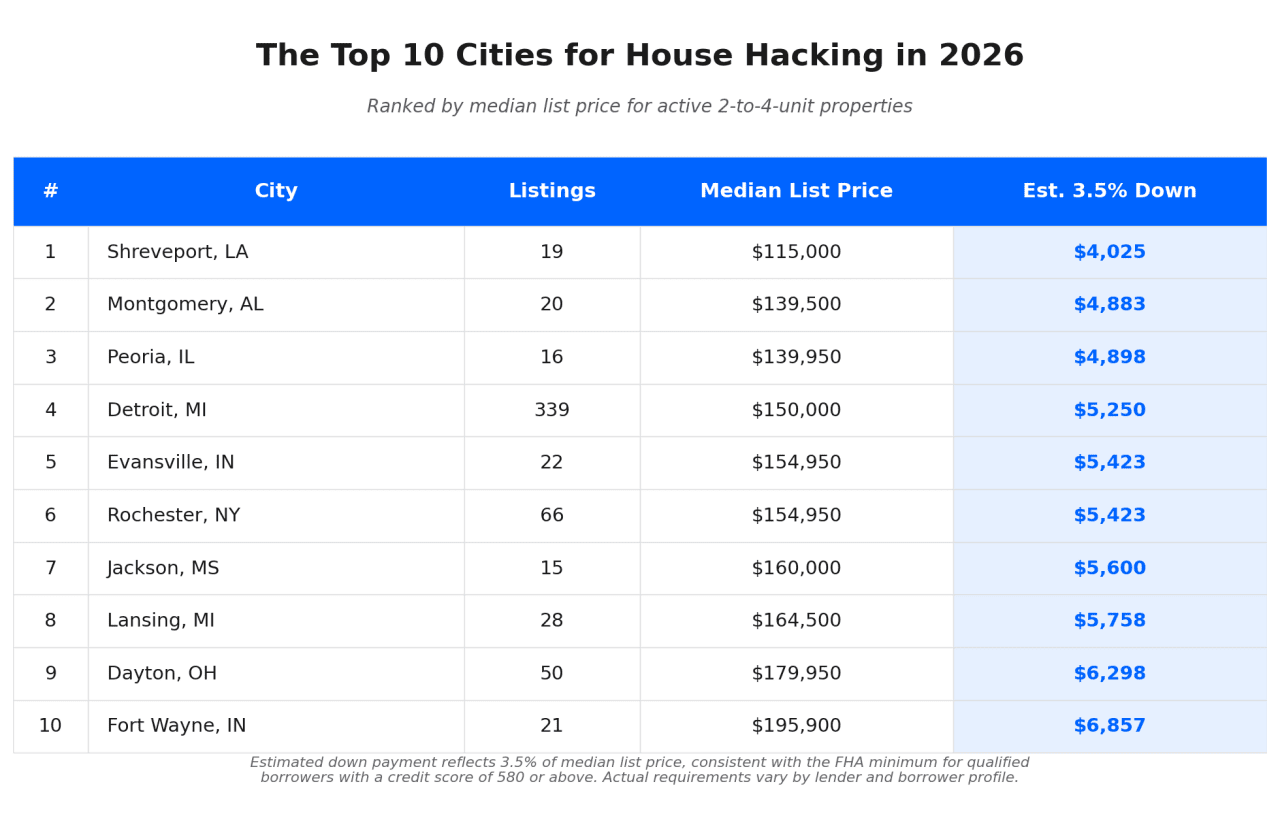
The following cities ranked highest based on median list price for active two-to-four-unit properties, among cities with a population of 100,000 or more and at least 10 qualifying listings on Movoto.
House hacking is the practice of purchasing a small multifamily property, occupying one unit as a primary residence, and renting out the remaining units. It's not a new concept, but it's gaining renewed attention as affordability pressures push first-time buyers to think creatively.
The strategy works particularly well for buyers who:
Importantly, FHA financing for two-to-four-unit properties requires owner occupancy — meaning the buyer must live in one of the units as their primary residence. This distinguishes house hacking from traditional real estate investing, and it's what makes the low down payment option available.
There are some additional caveats to keep in mind when it comes to house hacking with an FHA loan.
First, the 3.5% FHA loan requirement isn't universal. Some lenders apply overlays, meaning they might require additional down payments beyond that 3.5%. And on top of that, you'll need a credit score of 580 or higher to qualify for 3.5% down with an FHA loan.
Second, the down payment is only part of cash to close. Closing costs can total 2% to 6% of the purchase price, although FHA loans allow eligible closing costs to be covered through seller concessions. FHA loans also require both an upfront and ongoing mortgage insurance premium, or MIP. The upfront MIP is 1.75% of the loan amount, although that too can often be financed into an FHA loan.
Nine of the top 10 cities are located in the Midwest or South, reflecting where multifamily housing stock remains both plentiful and affordable relative to the rest of the country.
Cities like Detroit and Lansing in Michigan and Dayton, Ohio, have long had strong multifamily housing stock shaped by decades as manufacturing hubs. That legacy, combined with more modest home price appreciation compared to coastal markets, makes them natural fits for buyers looking to stretch their dollars.
Southern cities like Shreveport, Louisiana; Montgomery, Alabama; and Jackson, Mississippi, round out the top of the list, offering even lower entry points, and in Shreveport's case, a median list price of just $115,000, which translates to an estimated down payment of roughly $4,000.
Rochester, New York, is the notable exception in the top 10 and the only Northeastern city to crack the list with 66 active multifamily listings and a median price of $154,950, on par with Evansville, Indiana.
Lower analyzed active residential listings from its digital real estate portal Movoto's proprietary database to identify cities where multifamily homeownership may be most accessible to first-time buyers in 2026.
To qualify for inclusion, a city must have:
Cities were ranked by median list price among qualifying properties, from lowest to highest. The estimated down payment is calculated as 3.5% of the median list price, reflecting the FHA minimum for qualified borrowers with a credit score of 580 or above. Actual FHA loan requirements vary by lender and the borrower's financial profile.
This report is intended to highlight markets with lower upfront barriers to entry for owner-occupied multifamily homeownership. It does not estimate mortgage qualification, debt-to-income ratios, rental income, cash flow, return on investment, or any other measure of investment performance.
This story was produced by Lower and reviewed and distributed by Stacker.


