October 21, 2026



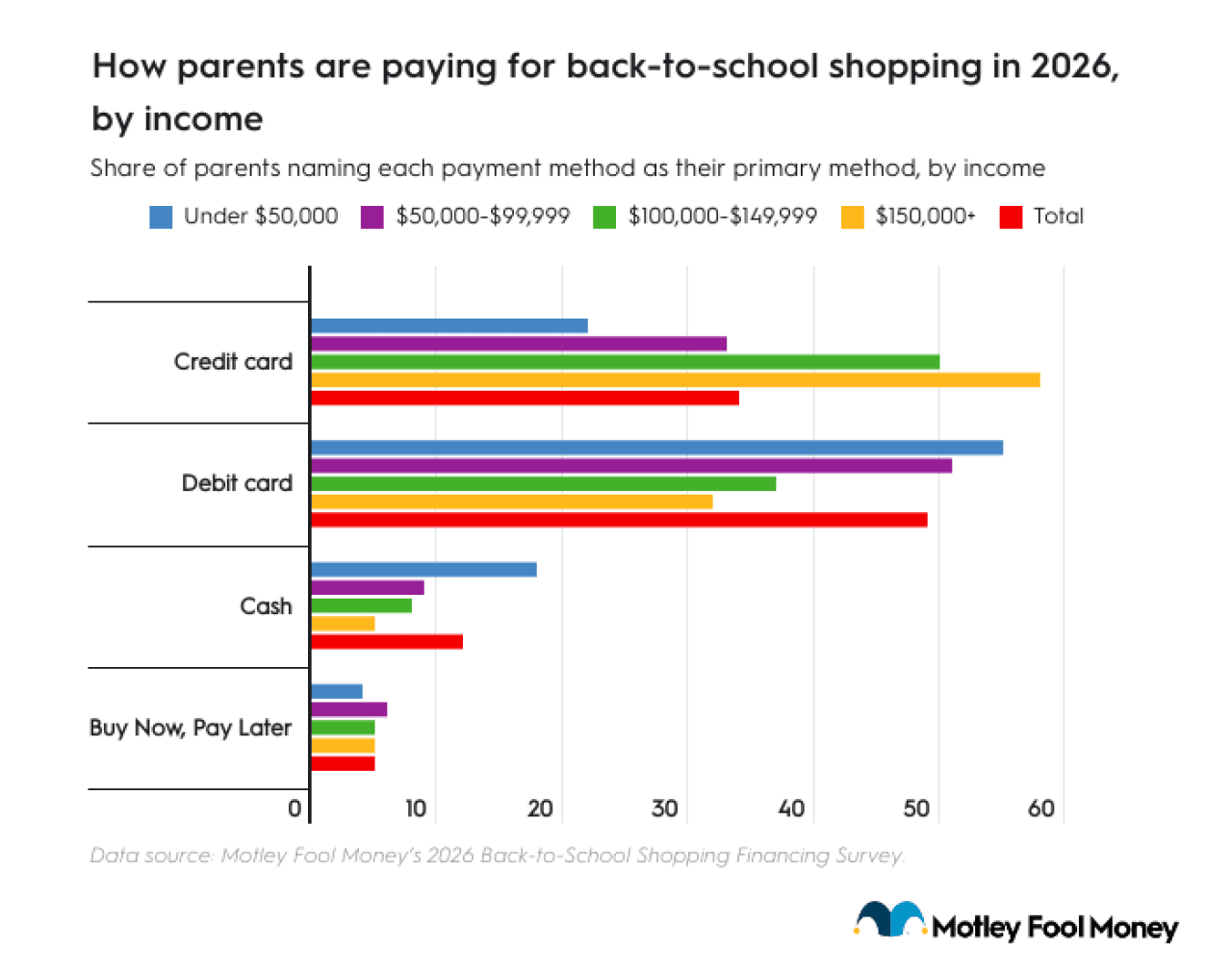
A third of parents will use a credit card as their primary payment method for back-to-school shopping this year, according to a Motley Fool Money survey of 2,000 parents of K-12 students in the U.S. conducted in July 2026.
With back-to-school shopping expected to average around $864 per family this year, according to the National Retail Federation, that is a significant expense to put on a credit card, though most parents said they would only charge a portion of their total spending on one.
Higher-income families—those making $150,000 or more a year—are largely choosing to use a credit card for back-to-school shopping, citing rewards and convenience as their top reasons. Tellingly, they're also the least likely income group to say they're spreading payments out over time, the clearest sign their credit card use is a choice, not a cash-flow crutch. Lower-income earners, who earn less than $50,000 a year, by contrast, are more likely to say they're concerned about affording their back-to-school shopping bill. For a third of American parents in 2026, back-to-school shopping is as much a financing decision as a spending one.
Back-to-school spending is projected to reach $43.3 billion this year, an average of $864 per family, according to the National Retail Federation. Motley Fool Money’s survey finds a clear divide in how parents are paying for it.
The income divide points to two different reasons parents reach for a credit card for back-to-school shopping: one driven by need, one by preference. The next section explores why.
Nearly half of parents earning $150,000 or more (49%) expect a credit card to cover 76% to 100% of their back-to-school spending this year, compared with just 11% of parents earning under $50,000.
Picture two families buying the same back-to-school list. For a family earning under $50,000, leaning on a credit card for most of that bill tends to come with real financial stress: This income group is also the most likely to say it is extremely concerned about affording the season at all. For a family earning $150,000 or more, the same choice looks more like optimization than necessity: This group is the least likely to be worried about their back-to-school shopping bill and the most likely to say convenience or rewards, not need, is the reason for using a credit card.
"Depending on where you shop, category rewards cards can give your rewards a real boost," said Joel O'Leary, a Motley Fool Money personal finance expert. "For example, if you're grabbing most of your supplies on Amazon, lean on a card that pays extra for online purchases. And if you're opening a new card to snag a welcome offer, travel cards tend to carry the biggest offers, an easy chunk of cash toward your next family trip."
Back-to-school shopping's tight timeline can also make hitting a new card's welcome offer easier than usual. "Most welcome offers are designed so an average family can earn one through regular monthly spending. School shopping just speeds up the timeline," O'Leary said. "If you're going to drop, say, $850 on school supplies over the next couple months, you're most of the way to a $1,000 minimum spend requirement. The bigger your budget, the easier the math works."
Preference more than necessity explains the pattern: Higher-income parents aren't financing more of their back-to-school shopping because they need to. They're doing it because a credit card pays them back.
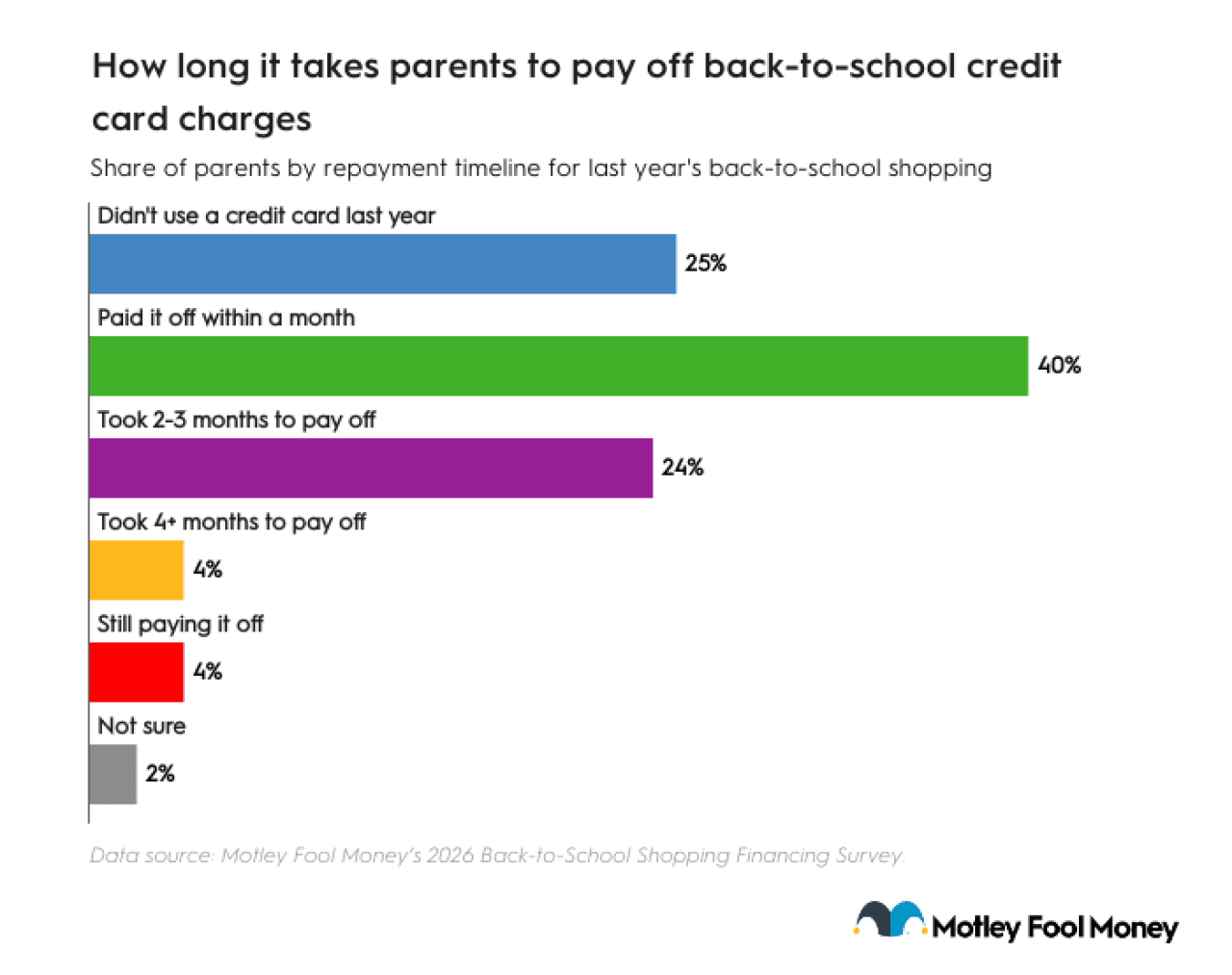
Last year's back-to-school shopping offers a preview of how this year's charges are likely to play out.
For families weighing whether to pay off charges over several months rather than in one shot, the type of card matters. "If you can clear the balance in a month or two, a regular card is perfectly fine," O'Leary said. “But if a big electronics haul will take several months to pay off, a card with a 0% intro APR on purchases buys you that time with zero interest. Just make sure you pay that debt off as quickly as you can, so you don't get stuck with the regular APR after the promo period ends.”
For parents still carrying last year's charges into this year's shopping season, there's a specific fix worth considering. "A balance transfer can absolutely reset the clock, and it's one of my favorite moves for old debt," O'Leary said. “It makes the most sense when the balance is big enough that a transfer fee, usually 3% to 5%, is worth paying. If you're staring down 20%-plus interest and need several months, pausing that interest can save you real money. Small balances you'll clear quickly probably aren't worth the fee.”
This slow-payoff pattern is not unique to the back-to-school shopping season. Outside of back-to-school shopping, 45% of parents say they pay their credit card balance in full every month, and 19% regularly carry a balance month to month, according to Motley Fool Money’s survey. For the roughly 1 in 5 that carry a balance each month, adding at least part of a nearly $864 back-to-school bill to a balance that's already accruing interest can make the season cost more than the sticker price suggests.
Buy now, pay later (BNPL) has moved from a niche checkout option to a mainstream one for many parents, and back-to-school shopping makes it an easy service to reach for.
Younger parents are once again the most open to a financing option that older generations are more likely to pass on entirely. Motley Fool Money's broader buy now, pay later research tracks this shift across categories beyond back-to-school shopping.
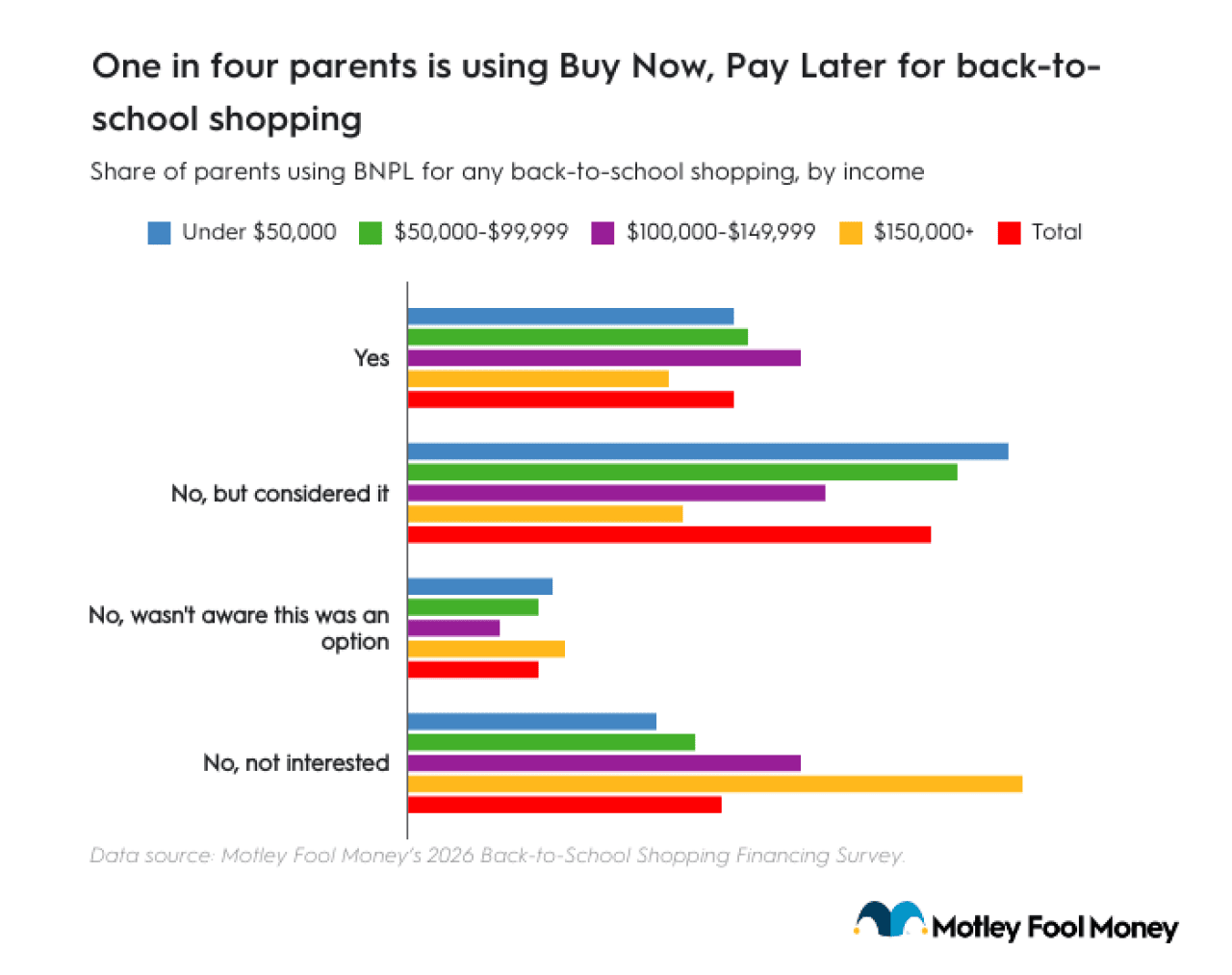
The clearest divide in back-to-school financing is not between parents who use credit and parents who do not. It is between parents using a credit card by preference and parents using one by necessity. High-income families are choosing a credit card for back-to-school shopping for convenience and rewards. Low-income families are the ones most anxious about the bill.
For families feeling the squeeze rather than chasing the rewards, building a budget for back-to-school costs ahead of time may matter more than which payment method they use.
Motley Fool Money's 2026 Back-to-School Shopping Financing Survey was designed to measure how parents of K-12 students are financing back-to-school shopping this year, including credit card usage, carried balances, and buy now, pay later adoption.
The survey was conducted via Pollfish on July 14, 2026, and included 2,000 American parents, aged 18 and older, who reported having already made or planning to make back-to-school purchases for a K-12 child this year. Pollfish reaches respondents through apps and websites they already use, rather than through opt-in survey panels, which helps reduce the self-selection bias common in online research. Results were weighted by age and gender to reflect the U.S. adult population, using U.S. Census Bureau benchmarks. The margin of error for the full sample is approximately 2.2 percentage points at the 95% confidence level.
Income tiers referenced in this piece reflect the household income bands collected in the survey and are defined as follows: low income (under $50,000), middle-low income ($50,000 to $99,999), middle-high income ($100,000 to $149,999), and high income ($150,000 or more).
Generational definitions used throughout: Gen Z (born 1997-2012), millennials (born 1981-1996), Gen X (born 1965-1980), baby boomers (born 1946-1964).
This story was produced by Motley Fool Money and reviewed and distributed by Stacker.


