October 1, 2026



A purchasing card, known as a p-card, is a company-issued charge card built for routine procurement, paid in full each cycle, with pre-spend controls that block out-of-policy purchases at the register. A business credit card is a revolving line of credit built for flexibility, with rewards and broader controls that the finance team reviews after the fact. The two products enforce policy in opposite ways: P-cards prevent, credit cards detect.
Most mid-market teams end up running both, or a single modern corporate card program that combines attributes of both cards. This guide from Ramp covers the six differences that help decide the choice, when each card fits, and how the two are starting to overlap in 2026.
A purchasing card or p-card is a company-issued commercial charge card used for routine business procurement. It replaces the traditional purchase order chain (requisition, manager approval, PO issuance, invoice matching, three-way match, payment) with a card that carries the approval logic.
The employee swipes or enters the card at an approved vendor for an approved category and within an approved amount, and the transaction clears. Anything outside those parameters gets declined at the point of sale. Because the controls sit in front of the purchase, most of the traditional accounts payable paperwork goes away.
There are two design details that define a p-card:
P-cards are common in mid-market and enterprise procurement functions, government agencies, and universities. They're most useful for recurring low-value spend like office supplies, maintenance, repair, and operations (MRO), small tools, and subscription renewals, where the cost of running a full PO cycle outweighs the value of the purchase itself.
A business credit card is a revolving line of credit issued in the company's name. Unlike a p-card, you can carry a balance from cycle to cycle, pay a portion, or pay in full, with interest accruing on any unpaid balance.
The controls for business credit cards are broader. You typically get one credit limit for the account (or per cardholder), a set of merchant categories that can be blocked but usually aren't, and monthly spend visibility through a statement or a linked expense platform. Enforcement is post-purchase: The transaction clears first, then someone in finance reviews it for policy compliance and coding.
Business credit cards are also designed to be flexible. They fund travel and entertainment, emergency purchases, marketing spend, one-off vendor payments that fall outside a formal procurement process, and any other expense where the specific vendor and amount are hard to predict in advance. Most come with rewards like cash back, points, or travel benefits, which p-cards typically don't.
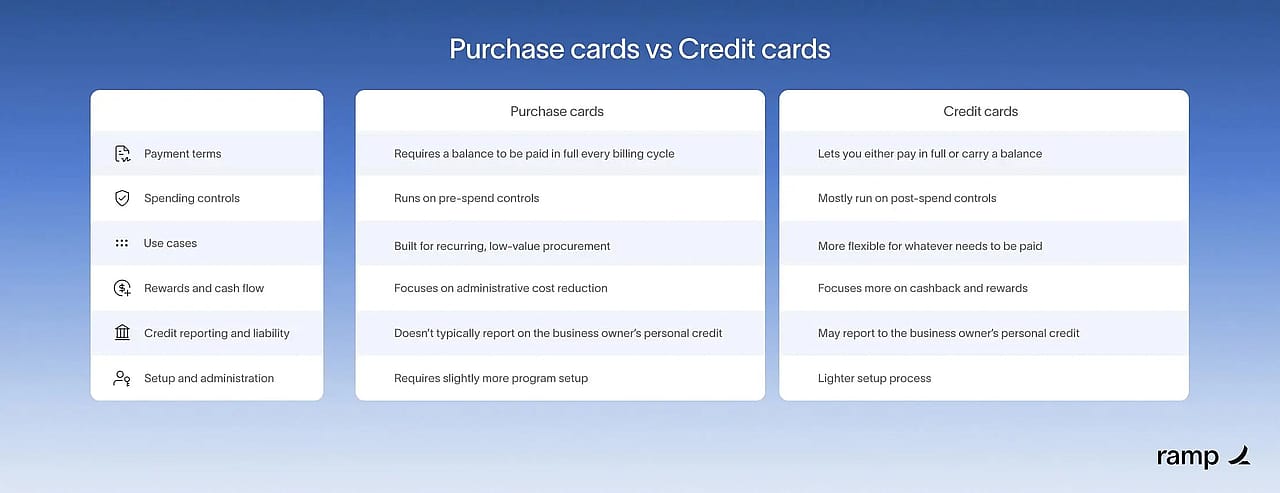
Payment terms
P-cards require that the balance be paid in full every billing cycle. There's no revolving credit and no interest.
Business credit cards let you either pay in full or carry a balance. Carrying a balance triggers APR, which on business cards can reach the high 20s. If your team has cash-flow gaps, that flexibility is valuable.
Spending controls
P-cards run on pre-spend controls. The card is preconfigured to block whole categories of merchants, cap the transaction size, or restrict users to a specific vendor. A cardholder trying to buy something outside those bounds is declined at the register.
Business credit cards mostly run on post-spend controls. The transaction clears first, and your finance team catches out-of-policy spend during the monthly review, which is usually weeks after the purchase.
Use cases
P-cards are built for known, recurring, low-value procurement like office supplies, safety equipment, ongoing subscriptions, and small operational expenses where the same category and same vendor come up month after month.
Business credit cards are more flexible for whatever needs to be paid. This includes travel bookings, client dinners, marketing campaigns, one-off consultant fees, and other general company expenses.
Rewards and cash flow
P-cards focus on administrative cost reduction instead of rewards. The value comes from cutting the PO cycle for low-value purchases, not from a rewards program.
Business credit cards focus more on cashback, points, and travel benefits, and they can materially offset spend at scale.
Credit reporting and liability
Some business credit cards report to the business owner's personal credit, require a personal guarantee, or both. Most p-cards and most true corporate cards from modern issuers don't. If protecting personal credit is a priority, ask specifically about reporting and guarantee terms before you commit.
Setup and administration
P-card programs require more setup work because someone has to define which cardholders exist, which categories each card can hit, what per-transaction caps apply, and how the transactions map to your general ledger. That work pays for itself once the program runs.
Business credit cards are lighter to stand up. You apply, get approved, hand out cards, and start reviewing statements. The trade-off is more manual policy enforcement downstream.
A p-card is the right tool when:
Common p-card use cases include:
A business credit card is the right tool when the spend is flexible, hard to predict, or wraps around travel and hospitality:
Business credit cards work best when policy enforcement is achievable through monthly review. For example, you can either configure a rule that alerts on high-dollar airfare (post-purchase) or you can trust cardholders and audit at close (also post-purchase).
Rewards value scales with spend. If your travel and vendor spend runs into six or seven figures a year, a rewards-oriented business credit card is meaningful revenue back.
The traditional split, p-card for procurement and credit card for everything else, was a real constraint 10 years ago because most issuers built the two products separately. But now, that's changing.
Modern corporate card platforms let you configure a single card program that combines the benefits of both cards:
Teams under 500 employees might consider a single corporate card platform that combines attributes of p-cards and credit cards, with controls configured per employee, per department, or per vendor, rather than two separate programs.
Choosing between a p-card and a credit card for your business isn’t a binary decision anymore. The controls that used to require a separate p-card program, like category blocks, per-transaction caps, vendor-specific spend, and virtual cards, now live inside modern corporate card platforms as configurable features.
The practical question is which combination of controls you need for which spend category, and whether you'd rather run one program with those controls layered in or two separate programs.
This story was produced by Ramp and reviewed and distributed by Stacker.


